Quick or complete
Four questions if you're in a hurry, or the long form with group focus and exclusions.
Tell VortLoop what you're looking for, how many days you can train, and what equipment you have. The AI builds the complete program, exercise by exercise, and shows you what it covers and what it doesn't.
Manual routines and complete library, free · AI generation in Pro
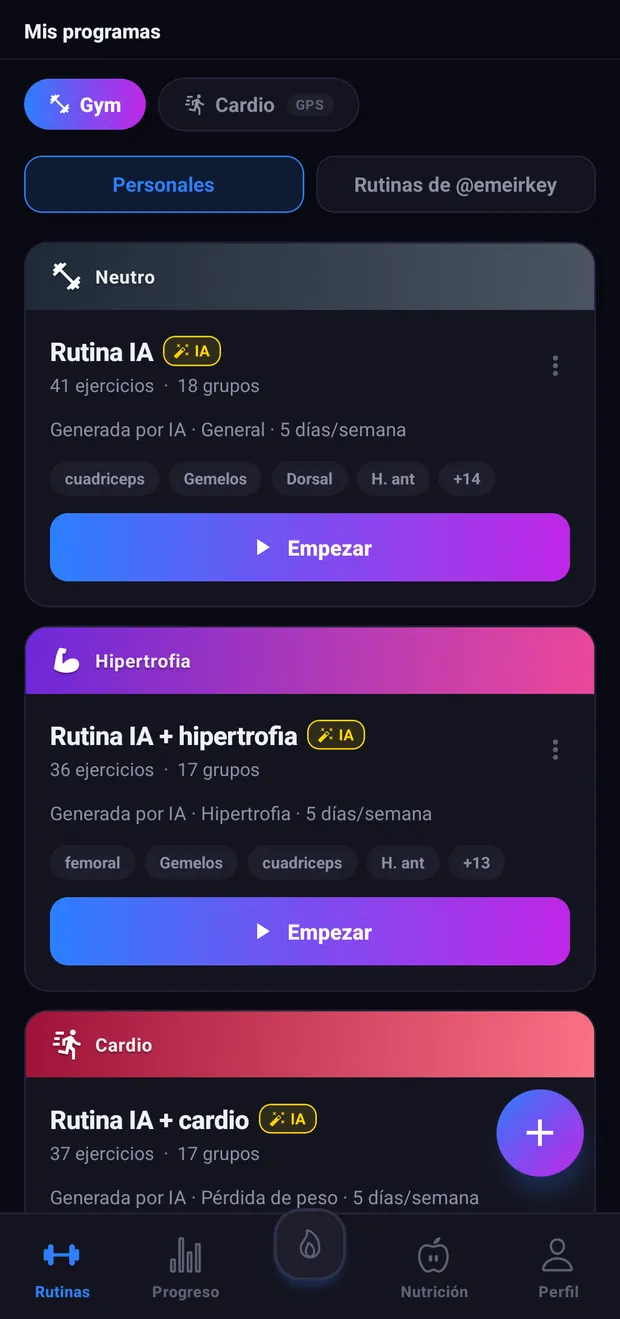
Goal, days per week, available equipment, and level. With that, the AI distributes muscle groups per session, chooses exercises from the library, and adjusts sets and reps to the goal you gave it.
Four questions if you're in a hurry, or the long form with group focus and exclusions.
Full gym, dumbbells at home, or bodyweight. It only proposes what you can actually do.
For weight loss, it adds alternating cardio blocks. For hypertrophy, not unless you ask for it.
It is validated against real exercises and out-of-range values are corrected before saving.
Generating the routine is the easy part. The hard part is the screen you glance at between sets, in a hurry and sweating. That one is redesigned around a single thing: the stopwatch.
Large, easy-to-read stopwatch at a glance. It doesn't start on its own: it starts when you start.
Log each set yourself, or let the app chain sets and rests for you.
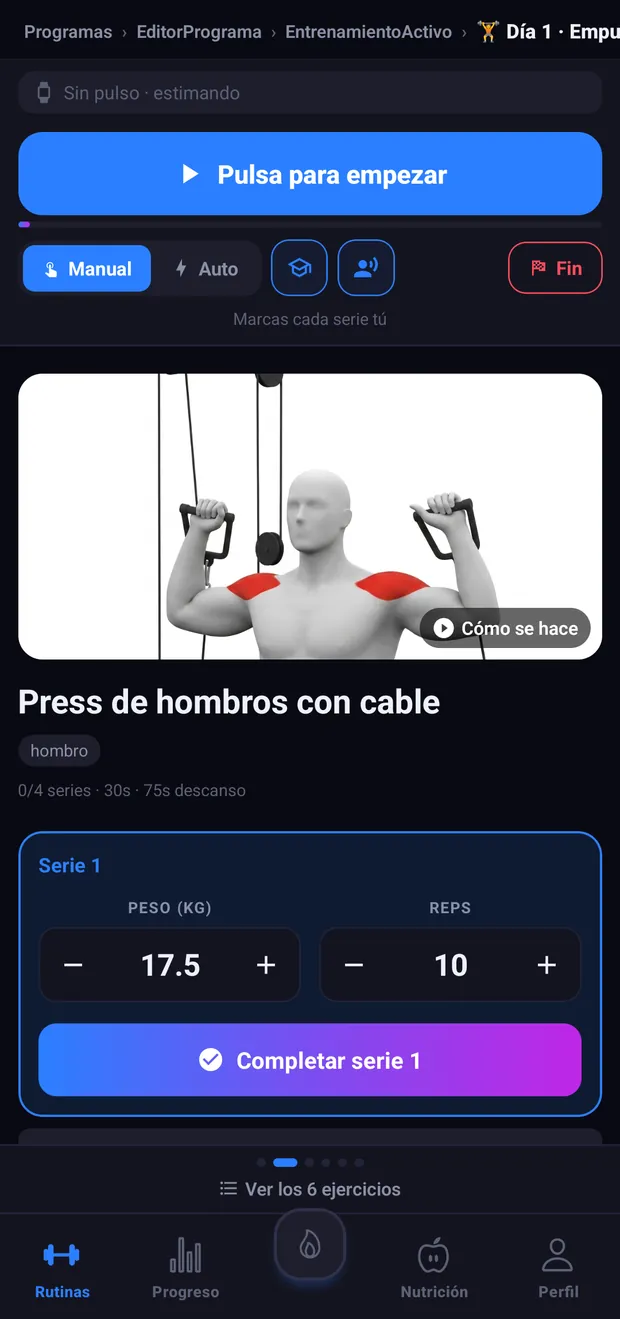
Spoken and haptic alerts so you don't have to look at the screen in the middle of a set.
If you beat your mark in an exercise, the app recognizes it and logs it as a personal record.
The routines floating around forums and videos are written for an imaginary reader: someone who trains five days, has access to a squat rack, carries no injuries, and has an hour and a half.
You train three days, two of them in a hurry, in a gym where the rack is always taken. Copying that routine means skipping exercises, improvising substitutions on the fly, and ending up training the same group three times while another goes untouched for a month.
VortLoop's generator starts from the opposite end: first your constraints, then the program.
There are two paths. The fast mode asks for the minimum: goal, days per week, equipment, and level. The full mode adds fine control: which groups to emphasize, which exercises to exclude, maximum exercises per session, and cardio preferences.
With that, generation distributes muscle groups across available days avoiding absurd overlaps, picks specific exercises from an 887-movement library, assigns sets and reps coherent with the goal, and orders each session placing strength work before cardio.
A loose language model invents non-existent exercises, sets twelve squat sets, and proposes forty-second rests for max strength work. That's not a routine, it's text that looks like one.
That's why generation isn't published as is. Before saving, it checks that each proposed exercise actually exists in the library and adjusts values outside reasonable ranges. If the AI misses the required cardio block, it's added with a fixed rule instead of leaving it halfway.
The result is that the routine reaching your screen is always executable: all exercises exist, all have instructions, and none ask for equipment you said you don't have.
A generated routine isn't untouchable. You can edit any day, change exercises, add sets, or delete what doesn't fit. AI gives the starting point, not the final word.
The library covers 887 movements with their name in your language, execution instructions, needed equipment, and muscles worked.
And not just the main muscle: each exercise has an activation map distributing from zero to one hundred the involvement of each muscle. This lets us tell you your week is push-heavy and pull-short, instead of just counting exercises.
There is also a three-dimensional anatomical viewer to see which area engages in each movement, especially useful when learning a new exercise or choosing between variants.
When your goal is fat loss, the routine includes cardio blocks spread across strength days, avoiding heavy cardio right after a leg session.
During training, a cardio block doesn't behave like a set: it has its own card with a countdown, voice alerts at sixty and ten seconds, a halfway hydration reminder on long blocks, and auto-completion at zero.
If you prefer going outside instead of the treadmill, that's the other pillar: GPS cardio and territory conquest.
Each program has an analysis screen answering questions no one usually answers: which muscle groups it covers and which fall short, how long each session really lasts counting rests, and the strength-to-cardio ratio.
It's the difference between training with a plan and training with a list. A list tells you what to do today; a plan tells you if the whole makes sense.
You can clone routines published by other users and adapt them to your equipment, and review the ones you've tried so good ones rise and bad ones sink.
And if you work with a trainer using VortLoop, their plans reach your app directly: they edit from their dashboard and you train from your phone, with the same session engine. Explained fully on the VortLoop for professionals page.
Freeletics is the benchmark in algorithm-generated training. The main difference is who controls the plan: broken down in VortLoop vs Freeletics.
The 887-exercise library, the viewer, unlimited manual routine creation, the voice and haptic training engine, personal records, and history are in the Free plan.
AI generation is part of paid plans, with a daily generation limit and a brief interval between them to prevent abuse. Check the plans comparison.
Download VortLoop for free and get the full app.