Scan the code
Point with the camera and you have the whole sheet. You can also search by name.
Counting calories tells you how much you've eaten. It doesn't tell you if it suits you. VortLoop scores each food according to your goal, explains why, and offers what to swap it with.
Scanner, diary, water and supplements: all in the free plan
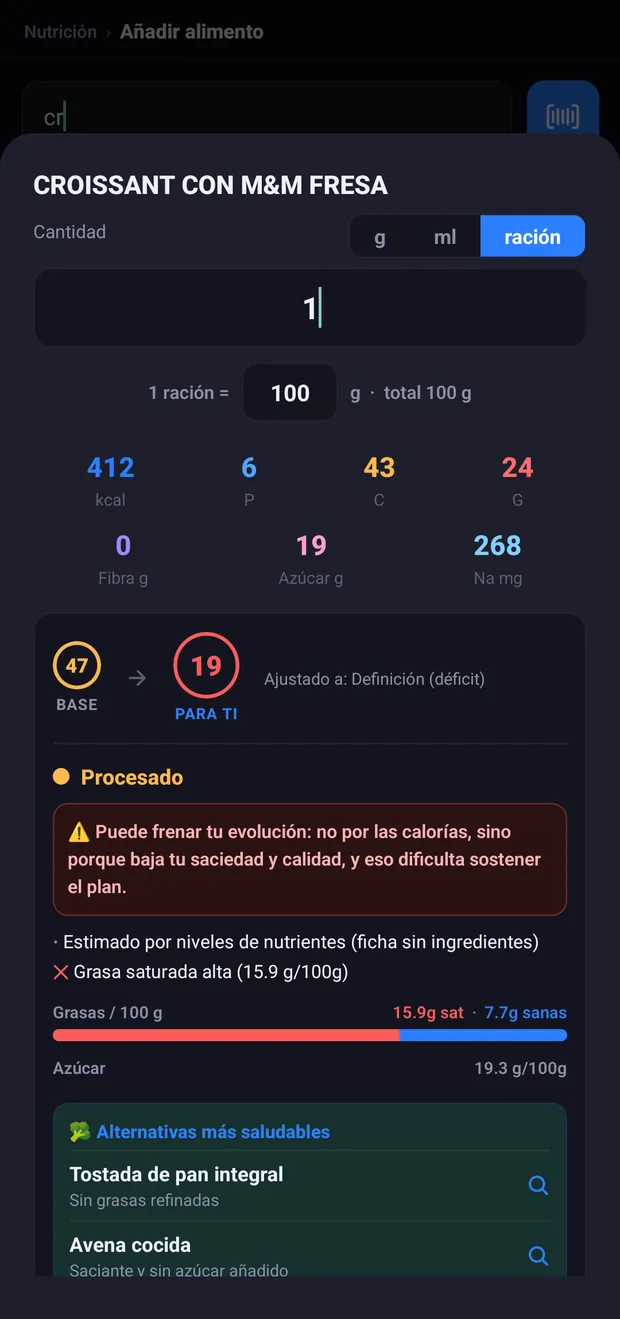
The same product sheet as in other apps ends with a calorie number, here it continues: quality grade, warning reason, fat breakdown and concrete alternatives you can add with one tap.
Point with the camera and you have the whole sheet. You can also search by name.
The base food score and the score adjusted to your current goal.
High saturated fat, high sugar, moderate salt. With the per 100 g figure right in front.
Real alternatives with a reason, searchable and instantly addable to your diary.
Four times of a day, one-tap water and macros always visible. If logging food takes effort, it gets abandoned in a week: that is why the screen is designed to take the absolute minimum time.
Breakfast, lunch, dinner and snacks, each with its own color and calories.
250 and 500 ml buttons over the daily recommendation of 2,000 to 2,500 ml.
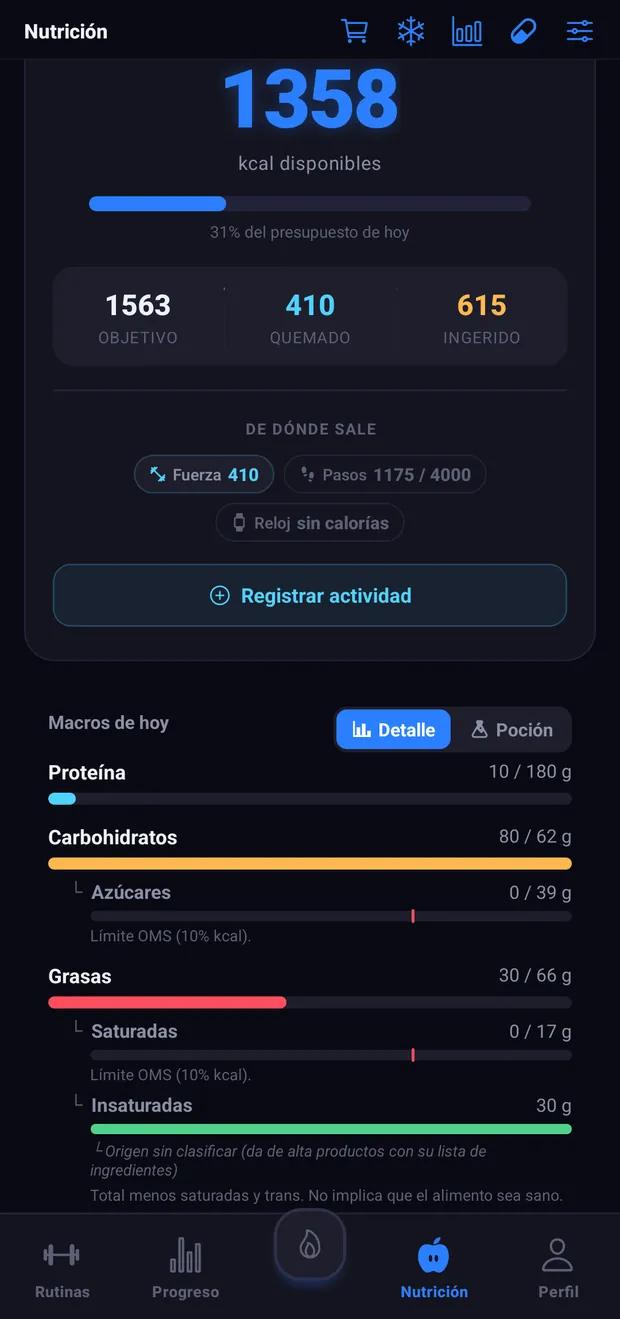
Protein, carbs and fats for the day and for each meal separately.
Track what you have at home and organize your shopping from the same tab.
Nutrition apps have been solving the same problem for fifteen years: how many calories you ate today. They do it well. The problem is that this number alone is a poor advisor.
Two 500 kcal breakfasts can be complete opposites. One with whole wheat toast, avocado and egg keeps you full for three hours and provides protein, fiber and good fat. Another with pastries leaves you hungry in forty minutes and with a sugar spike. The app shows you the exact same number and congratulates you equally for both.
And that is precisely the point where most people quit: not because willpower fails, but because they hit their calorie goal, get no results and do not understand why.
The VortLoop idea: calories are the framework, not the answer. What decides if a plan works is the quality of what is inside that framework.
You point the camera at the barcode, or search for the food by name, and the nutritional sheet shows calories and macronutrients just like any other app: protein, carbs, and fats. So far, nothing new.
Below that is where it gets different. Fiber, sugars, and sodium in grams per hundred. The product's processing level. A quality score from zero to hundred. And a second score, the one that really matters, which is that same grade recalculated for your currently active goal.
In the real example from the screenshot, a chocolate-filled croissant gets a base score of 39 and a 12 for someone in a cutting phase. It's not that the croissant changes: what changes is what that croissant means for that specific person's plan.
A banana before a workout and a banana at eleven at night during an aggressive deficit are not the same decision. A protein shake with added sugar might make sense in a bulking phase and be a burden in a cutting one.
Instead of giving a universal grade, VortLoop recalculates the score with your active goal. If you change phases, your diary grades change with you. What was a good choice yesterday might stop being one, and the app tells you without you having to learn nutrition to figure it out.
The warning that accompanies low grades isn't about calories either. It's about sustainability: heavily processed foods usually don't fill you up much for what they provide, and eating foods that aren't filling is what makes a plan fall apart by week three.
An app that scolds you is an app that gets uninstalled. VortLoop doesn't block foods or paint anything red with a reproachful tone: it logs what you've eaten and offers options for next time.
Each warning comes with specific alternatives below, with the reason they are proposed and a search bar next to them to add them directly to your diary. These aren't generic tips like "eat more vegetables": they are specific products that replace what you just logged.
There is also a comparator to put two foods side by side and see how they really differ, beyond what the packaging says.
This is where having all four pieces in the same app stops being just a convenience and becomes a calculation advantage.
What you spend training in the gym, what you burn in a GPS cardio session, and the activity you log manually are added to your daily balance. If you also connect a watch via Health Connect, the data it measures comes in too.
That has an obvious trap that had to be solved: if the watch counts a walk, the app counts the same walk and on top of that you log it manually, you end up gifting yourself calories you never burned. The rule VortLoop applies is a single source of truth per day and time slot, with explicit priority among sources, and never adding the app's workouts on top of the watch's total in the same interval. The origin of the expenditure is always labeled, so you know where each figure comes from.
There are also safety caps: a gym session left open for eleven hours cannot inflate your day with two thousand phantom calories.
When two figures do not match, trust in the whole app is lost. That is why we prefer a conservative and traceable number over a generous one.
You can log up to twenty supplements, each with its doses: the time and days of the week they are due. The app schedules local alerts on your phone, so they work even without coverage.
It is a deliberately simple feature with its warning always visible: VortLoop organizes your doses, it does not recommend what to take. That is up to a healthcare professional.
It is worth stating this as clearly as the above.
It is not a medical app nor does it replace a dietitian-nutritionist. It does not diagnose, treat conditions, and should not be used as a guide in eating disorders. It does not set calorie goals below reasonable thresholds or push eating less as a default strategy.
The quality score is an estimate calculated from the product's available nutritional information. In entries without an ingredient list, it is calculated by nutrient levels and indicated as such in the entry itself. It is a tool to decide better at the supermarket, not a verdict.
If you already use a nutrition app and are considering a switch, there are two feature-by-feature written comparisons, also acknowledging what they do better: VortLoop vs MyFitnessPal and VortLoop vs Yazio.
The scanner, diary, water, times of day, fridge, and supplements are in the Free plan, with no logging limits and no ads.
Paid plans add the intelligence layer: advanced food comparator, AI analysis, and analytics that cross nutrition with training and rest. You can view them on the plans page.
Download VortLoop for free and get the full app.