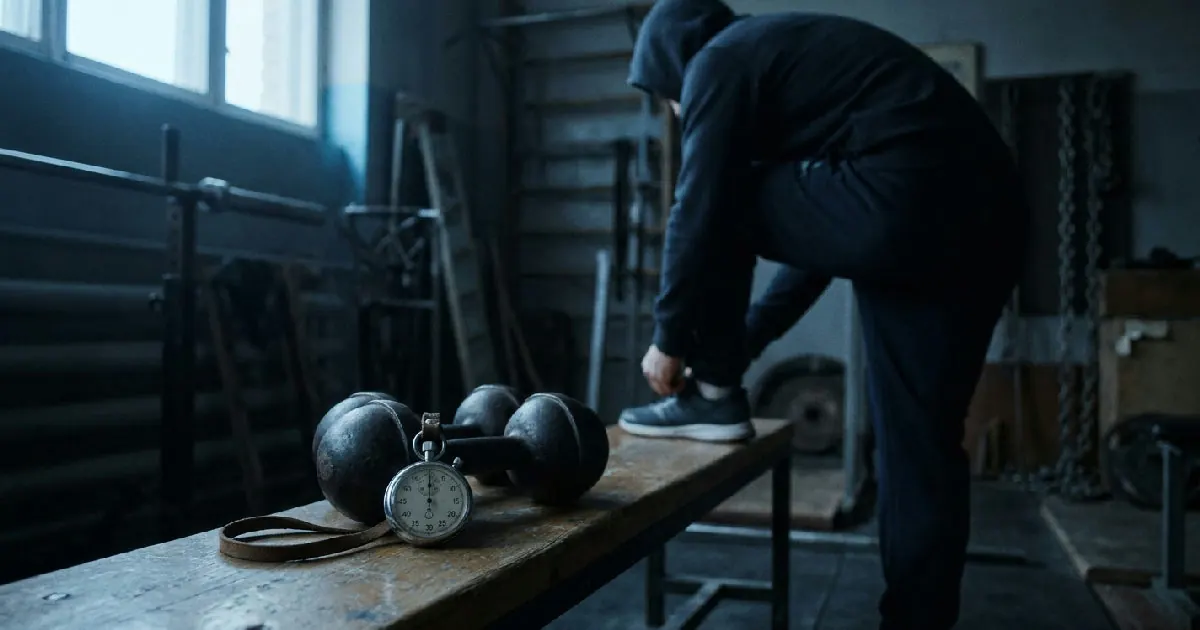
There's a moment in the gym that almost everyone treats as dead time. You finish a set, put down the weight, and your hand goes straight to your phone. You open Instagram, reply to a message, and when you feel ready, you go back to the bar. It seems like a pause, but it's a mistake.
My thesis is that rest between sets is not an interruption of the workout. It is a fundamental part of the workout itself. The duration of that "pause" radically changes the stimulus you are giving your body, even if the weight and repetitions are the same.
If you're looking for strength, you need one type of rest. If you're looking for muscular endurance, you need another. And if you're going "by feel," you're most likely not optimally achieving either.
Understanding this is the difference between truly progressing or getting stuck without knowing why. And it's exactly the kind of detail that at VortLoop we want to help you control so that every session counts.
Rest is not a pause, it's a variable
Think of rest as another tool in your box, just like weight, repetitions, or execution speed. It's not just a space to catch your breath. It's a crucial moment where your body prepares for the next effort, and that preparation takes different times depending on what you want to achieve.
If you don't give it the importance it deserves, you're leaving one of the most powerful levers for directing your training to chance. You're getting into a car with a loose steering wheel: you might get there, but not with the precision or safety you could.
The duration of rest is non-negotiable if you have a clear goal. It's a variable that deserves your attention as much as the number of kilos on the bar.
What recovers during rest
When you make an intense effort, like lifting a heavy weight, you quickly deplete certain energy reserves and fatigue your nervous system. The body not only needs oxygen, it needs to replenish what it has spent to be able to perform equally or better in the next set.
Mainly, we are talking about two things. First, the recovery of the central nervous system: the ability of your muscles to generate force depends on the signals sent to them by the brain. A fatigued nervous system does not send efficient commands.
Second, the replenishment of the ATP-CP (adenosine triphosphate-phosphocreatine) system. This is the energy source for explosive, maximum intensity efforts. It depletes in seconds and its complete replenishment takes time. Without it, you won't be able to move the same weight with the same power.
Long rests: the key to strength
If your goal is to gain maximum strength, you need to rest for two to three minutes, or even more for very heavy sets. This time is essential for your nervous system to fully recover and ATP-CP reserves to be replenished to the maximum. This way, when you start the next set, you'll be almost as good as new.
If you shorten that rest to, say, one minute, you're not training strength even if you use the same weight. You would be training something else, because your body hasn't had time to recover and won't be able to express its maximum power. It's like trying to run a 100-meter sprint right after another with hardly any break.
The goal of strength is to lift the maximum possible weight for the maximum number of repetitions in each set. For that, each set must start with your body in the best possible conditions. And that requires time, which is the long rest.
Short rests: another type of stimulus
On the other hand, if your goal is hypertrophy (muscle growth) or endurance, short rests (between 45 and 90 seconds) can be very effective. Here, the goal is not complete recovery, but to generate metabolic stress in the muscle.
By not allowing total recovery, you accumulate fatigue and metabolites, which causes a different adaptive response. You are forcing the muscle to work in a state of fatigue, which can be beneficial for these adaptations. It is a distinct stimulus, neither better nor worse, just different.
So, if you're in a hurry and rest forty seconds between heavy sets, you're not optimizing your strength training. You're transforming it into a workout more focused on endurance or work capacity, even if that wasn't your initial intention. The stimulus changes completely.
The problem with "by feel": the rest that sabotages you
Here's the big mistake many people make. People don't time their rest. They do it "by feel," and that almost always works against you. The perception of time is very subjective, especially when you're under the stress of training.
When a set has really hurt, we tend to extend the rest more than necessary, losing intensity and time. When we are in a hurry, we shorten it too much, just when we would need more time to recover our strength for the next heavy set.
It's a psychological trap. Your body asks for one thing, but your real goal in the gym asks for another. And without external control, the body usually wins this battle.
- Resting too little when the set has been very hard.
- Extending rest too much when you shouldn't.
- Getting distracted by your phone and losing track of time.
- Changing the type of stimulus without realizing it due to poor control.
Why you need to time it
Precision is key. You need to know that the rest you are taking is the one you have planned for your goal. A timer eliminates "by feel" and gives you real control over this important variable.
It's the only way to ensure that every set you do counts towards your specific goal. If your program says 3 minutes, it's 3 minutes. Not 2, not 4. That accuracy is what allows your body to adapt in the way you seek.
At VortLoop, we know how critical this is. That's why our app allows you to program the exact rest for each set and exercise. When you finish a set, the rest timer starts automatically. It notifies you when it's time to get back to action, without distractions or doubts. This way, every second of your workout is optimized.
Rest time is a variable as important as weight or repetitions. Controlling it is controlling your progress.
Adapt rest to your goal
There is no single "correct" rest duration. What is correct depends entirely on what you want to achieve at that moment. If in one phase you are looking for strength, long rests are non-negotiable. If in another you are looking for muscular endurance, short ones will be your allies.
Review your training plan and make sure the rest time is aligned with your goals. It's not just the weight you lift, it's the context in which you lift it. Rest is part of that context.
Stop seeing it as time to disconnect and start treating it as an active part of your training. It's the time where your body prepares to perform, and every second counts for the final result.